
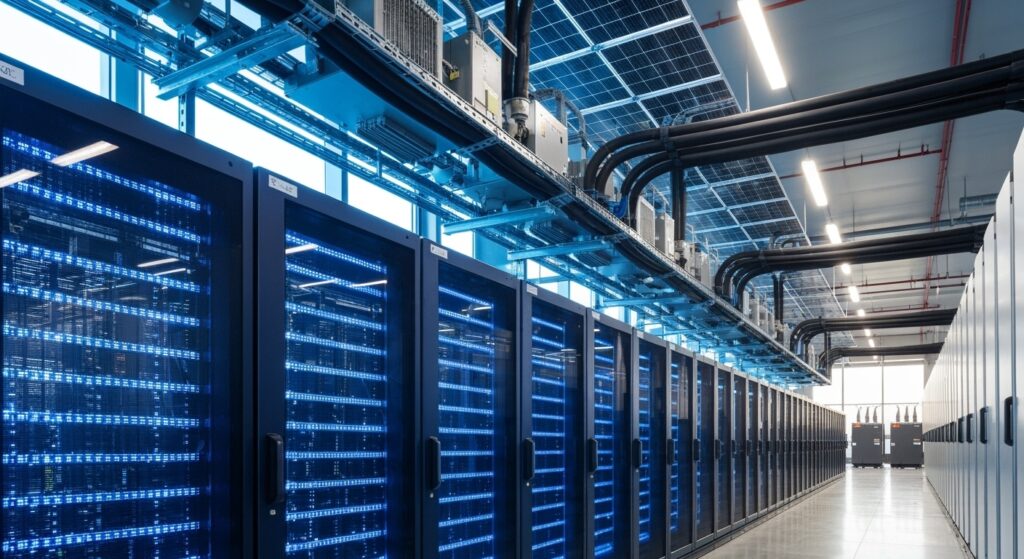
The explosive growth of artificial intelligence and cloud computing has created unprecedented demand for hyperscale data center facilities. Property owners and developers sitting on industrial real estate increasingly wonder whether their assets could serve this lucrative market. Understanding what makes a property attractive for hyperscale data centers requires examining specific technical, geographical, and infrastructural criteria that separate viable sites from unsuitable ones.
Hyperscale operators like Amazon Web Services, Microsoft Azure, and Google Cloud don’t simply need large buildings—they need properties that can support massive power loads, provide redundant connectivity, and offer room for exponential growth. The investment required to develop these facilities runs into hundreds of millions of dollars, making site selection a high-stakes decision that hinges on precise requirements.
Power Infrastructure: The Foundation of Hyperscale Operations
Power availability stands as the single most critical factor for hyperscale data center viability. These facilities consume electricity at scales that dwarf typical industrial operations. A single hyperscale data center can require 50 to 100 megawatts of power, with some newer AI-focused facilities demanding 200 megawatts or more.
The property must have access to utility-grade power infrastructure capable of delivering this capacity reliably. This means proximity to electrical substations with available capacity and the ability to accommodate multiple redundant power feeds. Properties located in areas where the electrical grid already operates near capacity face significant barriers, as utility companies may require years and substantial investment to upgrade infrastructure.
Beyond raw capacity, power costs matter enormously. Hyperscale operators scrutinize electricity rates down to fractions of a cent per kilowatt-hour, as energy represents 60-70% of ongoing operational expenses. Properties in regions with low electricity costs—typically areas with abundant hydroelectric, nuclear, or natural gas generation—hold substantial competitive advantages. What makes a property attractive for hyperscale data centers? involves analyzing these power economics alongside technical feasibility.
Network Connectivity and Fiber Infrastructure
Hyperscale data centers function as critical nodes in global information networks, making robust connectivity non-negotiable. Properties must offer access to multiple fiber optic network providers—ideally four or more—to ensure redundancy and competitive pricing. Single-carrier locations rarely meet hyperscale requirements.
The property’s proximity to internet exchange points and major fiber routes significantly impacts its attractiveness. Sites located near existing network hubs benefit from lower latency and reduced costs for establishing connections. Some operators specifically target properties within fiber-rich corridors that connect major metropolitan areas.
Latency considerations vary by use case. Content delivery networks and cloud computing applications tolerate moderate latency, allowing facilities in secondary markets. AI training workloads and high-frequency trading applications demand ultra-low latency, restricting viable properties to specific geographic zones near major urban centers.
Physical Space and Expansion Potential
Hyperscale operators think in terms of campus development rather than single buildings. The ideal property offers 50 to 100 acres of developable land, allowing phased construction of multiple data halls over 10-15 years. Properties that can only accommodate a single building rarely interest hyperscale developers.
Clear, flat topography with stable soil conditions reduces construction costs and complexity. Sites requiring extensive grading, soil remediation, or flood mitigation add millions to development budgets. Properties with existing concrete pads or industrial buildings may offer advantages if the structures can be adapted, though many operators prefer greenfield sites that allow purpose-built construction.
Ceiling height requirements for hyperscale facilities typically exceed standard industrial specifications. Modern data centers need 30 to 40 feet of clear height to accommodate raised floors, cable trays, and cooling infrastructure. Existing buildings with inadequate height face costly modifications or complete demolition.
Climate and Environmental Considerations
Geographic climate directly impacts cooling costs and operational efficiency. Properties in cooler climates allow greater use of free cooling—using outside air to remove heat rather than mechanical refrigeration. This can reduce energy consumption by 20-40% compared to facilities in hot climates.
Water availability matters for facilities using evaporative cooling systems, though many newer designs minimize water consumption due to environmental concerns. Properties in water-stressed regions may face regulatory restrictions or public opposition to high water usage.
Natural disaster risk assessment weighs heavily in site selection. Hyperscale operators avoid properties in flood plains, earthquake zones, hurricane corridors, or areas prone to wildfires. Even properties with acceptable risk profiles must demonstrate adequate setbacks and mitigation measures.
Regulatory Environment and Permitting
The local regulatory climate can make or break a hyperscale project. Properties in jurisdictions with streamlined permitting processes, supportive zoning regulations, and pro-business attitudes attract more interest than those in areas with complex approval requirements.
Tax incentives significantly influence site selection decisions. Many states and localities offer property tax abatements, sales tax exemptions on equipment purchases, or other financial incentives to attract data center investment. Properties in jurisdictions offering competitive incentive packages gain substantial advantages.
Environmental regulations around noise, water discharge, and emissions affect operational flexibility. Is my industrial property attractive to data center or IOS developers? depends partly on whether local regulations allow 24/7 operations with backup generator testing and other necessary activities.
Security and Access Control
Hyperscale facilities handle sensitive data for millions of users, making physical security paramount. Properties must allow implementation of multiple security perimeters, including fencing, vehicle barriers, and controlled access points. Sites with multiple public access points or adjacent residential development complicate security planning.
The property should offer sufficient setback from public roads and neighboring properties to establish secure perimeters and prevent visual surveillance. Operators typically require 100 to 200 feet of buffer space around the facility perimeter.
Transportation and Logistics Access
While data centers don’t generate significant daily traffic, they require good transportation access for construction, equipment delivery, and maintenance operations. Properties with direct access to major highways and the ability to accommodate oversized loads (transformers, generators, cooling equipment) meet this requirement better than those requiring navigation through residential areas or weight-restricted bridges.
Proximity to airports provides convenience for staff travel and emergency equipment shipments, though this factor carries less weight than power, connectivity, and land availability.
Frequently Asked Questions
What size property do hyperscale data centers typically require?
Hyperscale operators generally seek properties between 50 and 100 acres to allow campus-style development with multiple buildings. Smaller sites of 20-30 acres might work for single-building projects, but these rarely interest the largest operators who plan for long-term expansion. The land must be developable with minimal grading or environmental remediation.
How much power capacity does a property need for hyperscale development?
A viable hyperscale site needs access to at least 50-100 megawatts of electrical power, with some AI-focused facilities requiring 200+ megawatts. This power must be available from the local utility grid without requiring years of infrastructure upgrades. The property should accommodate multiple redundant power feeds from separate substations to ensure reliability.
Can existing industrial buildings be converted to hyperscale data centers?
Existing buildings can sometimes be adapted, but they must meet specific criteria: 30-40 feet clear ceiling height, robust structural capacity for heavy equipment loads, and sufficient floor space (typically 100,000+ square feet per data hall). Most hyperscale operators prefer greenfield development that allows optimized design, though adaptive reuse can work for smaller colocation facilities.
Why does climate matter for data center site selection?
Climate affects cooling costs, which represent a substantial portion of operational expenses. Cooler climates allow more hours of free cooling using outside air, reducing energy consumption by 20-40%. Properties in regions with moderate temperatures and low humidity offer the best thermal efficiency, though modern cooling technologies can make facilities viable in most climates.
What role do tax incentives play in site selection?
Tax incentives significantly influence competitive site selection. Many jurisdictions offer property tax abatements, sales tax exemptions on equipment, or other financial benefits worth millions of dollars over a facility’s lifetime. Properties in areas offering competitive incentive packages become more attractive than otherwise equivalent sites without such benefits.
How important is fiber connectivity compared to power availability?
Both are essential, but power typically acts as the primary constraint. A property can attract fiber providers if other factors prove attractive, but inadequate power infrastructure may be impossible to overcome economically. Ideal sites offer both robust power and existing fiber connectivity from multiple carriers, eliminating the need to extend either infrastructure.
Conclusion
The convergence of AI advancement and cloud computing expansion has transformed industrial property evaluation. Properties that meet hyperscale data center requirements—abundant power, robust connectivity, adequate land, and favorable regulatory environments—command premium valuations and attract significant investment. Not every industrial site can serve this market, but those with the right combination of characteristics offer owners compelling development or sale opportunities.
As AI infrastructure demands continue growing, property owners should assess their assets against these criteria sooner rather than later. The most attractive sites will be claimed by operators making long-term commitments, while marginal properties may see this opportunity pass. Understanding these requirements provides the foundation for making informed decisions about whether to pursue data center development or focus on alternative industrial uses.